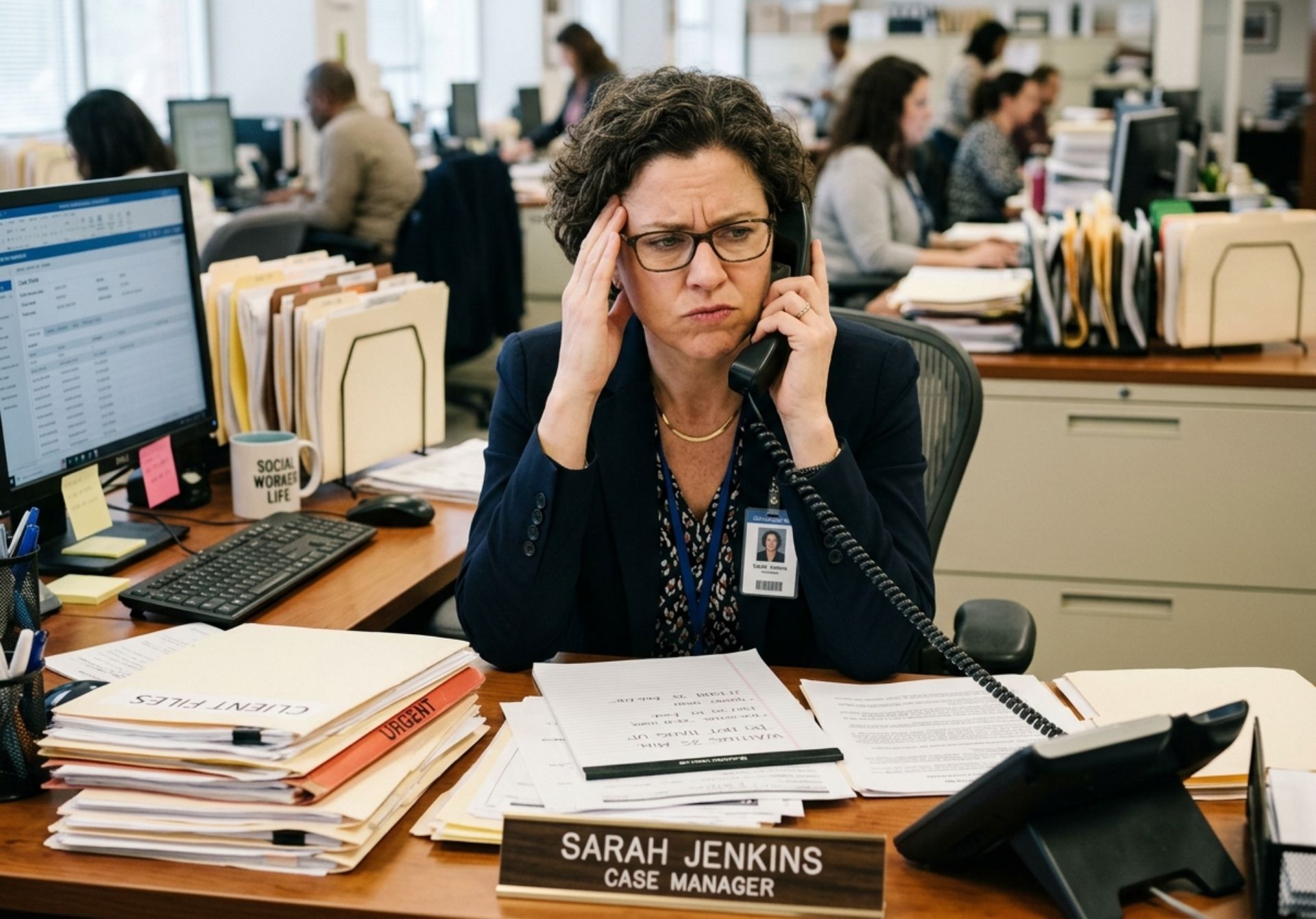
Ask any case manager at a personal injury law firm what eats up their day, and pharmacy calls will come up fast. A client's prescription gets rejected. A card isn't activating. A pharmacy can't find a prior authorization. What should be a minor administrative task turns into a 30-minute back-and-forth — and it happens multiple times a day, across dozens of active cases.
The frustrating part is that most of these calls shouldn't need to happen at all. They're not complex clinical conversations or nuanced legal discussions. They're status checks. And status checks are exactly what technology is built to eliminate.
So why is your case manager still spending so much time on the phone? The answer usually comes down to one of four root causes.
Root Cause #1: Your Lien Provider Doesn't Have a Real Portal
Many pharmacy lien providers operate with systems that were designed before modern software expectations existed. Their "portal" might be a basic login screen that shows a list of enrolled clients with a status field — and not much else. There's no fill history, no invoice access, no spend limit controls. If you want to know anything beyond a green or red status dot, you have to call.
This isn't just inconvenient. It's a structural problem that compounds across your entire caseload. The larger your firm grows, the more calls this generates — and it scales linearly. Double your cases, double your call volume.
What a real portal looks like: Live card status, full prescription fill history with dates and amounts, auto-generated invoices per transaction, and direct spend limit controls — all without picking up the phone.
Root Cause #2: Clients Don't Know What to Do When a Fill Is Rejected
A pharmacy rejection almost always triggers a client call to your office. The client is frustrated, possibly in pain, and needs the issue resolved immediately. Your case manager then has to diagnose what went wrong — was it a data entry error at the pharmacy? A card that wasn't activated in time? A formulary issue? — and coordinate a fix.
Without visibility into what happened on the backend, this requires a call chain: client → case manager → lien provider → pharmacy → case manager → client. Each handoff adds time and introduces the possibility of miscommunication.
Firms that reduce this loop have two things in common: they can see exactly what happened in a portal the moment the client calls, and they've given clients a clear reference card with the information pharmacies need to process the claim correctly on the first try.
"Half the time the pharmacy just entered the BIN wrong. If we could see the rejection reason instantly, we'd fix it in two minutes instead of twenty."
Root Cause #3: Invoices Aren't Automatically Generated
Settlement preparation is one of the most invoice-intensive parts of personal injury case management. Attorneys need itemized documentation of every prescription filled under the lien — drug name, date, amount, pharmacy location — to negotiate and close a case.
If your lien provider doesn't auto-generate invoices per transaction, getting this documentation means submitting a request and waiting. Multiply that across a full caseload approaching settlement and you've created a meaningful bottleneck at exactly the moment when time matters most.
The fix is straightforward: your lien provider should attach an itemized invoice to every fill automatically. It should be downloadable from the portal the moment it's created — no request, no wait, no follow-up email required.
Root Cause #4: There's No System for Proactive Monitoring
Most pharmacy-related case management is reactive. A problem surfaces — a rejected fill, an exhausted spend limit, an expired card — and then your team responds. This reactive mode is inherently inefficient because it means every issue has already affected the client before you're even aware of it.
The alternative is building a proactive monitoring habit into your workflow. That means:
- Checking each active client's portal status during your weekly case review — not waiting for a call
- Setting spend limit alerts so you're notified before a client hits the cap, not after
- Confirming card activation as part of enrollment close-out, not when the client calls from the pharmacy
- Verifying formulary coverage for prescribed medications before the client attempts to fill
None of these steps are time-consuming if the portal makes the information accessible. They become time-consuming only when you have to call to get it.
The Hidden Cost Nobody Talks About
Every firm that has analyzed this problem comes to the same uncomfortable conclusion: the time spent on pharmacy calls isn't just an inconvenience, it's a significant hidden labor cost that directly affects profitability.
Run the numbers: If a case manager handles 80 active files and averages 15 minutes per week per client on pharmacy-related calls and troubleshooting, that's 20 hours per week — more than half of a full work week — spent on tasks that a better system would eliminate entirely.
That time isn't free. It's either absorbed by your existing staff (reducing their capacity for higher-value work) or it's a hidden argument for hiring another person you may not actually need if your systems were better.
For growing firms, this is worth taking seriously. The case managers who are best positioned to support firm growth are the ones who spend their time on client relationships, case strategy, and settlement preparation — not hold music.
What the Fix Actually Requires
Solving the pharmacy call problem isn't about training your case managers to be more efficient. The workflow itself is broken. The fix requires addressing the system, not the person.
Concretely, that means evaluating your current lien provider against a clear set of capability requirements:
- Does the portal show real-time card status and prescription fill history?
- Are invoices generated automatically per transaction and available without a request?
- Can spend limits be adjusted directly in the portal?
- Are rejection reasons visible in the portal so your team can diagnose issues without calling?
- Does the provider offer alerts or notifications for low balances or card issues?
If the answer to most of those is no, the phone calls aren't going away — because they're baked into how your current provider operates. No amount of internal workflow improvement will fix a tools problem.
A Note on Switching Costs
One reason firms stay with underperforming lien providers longer than they should is the perceived complexity of switching. There's existing lien history on open cases, relationships with pharmacies, and the concern about disrupting active clients mid-treatment.
In practice, switching is less disruptive than it appears — especially if you manage it by enrolling new clients with the new provider while existing cases run out naturally. Most firms that have made this transition report that the workflow improvements were noticeable within the first month, and that the time savings far outweighed the one-time transition effort.
The more relevant question isn't whether switching is complicated. It's whether the current situation — your case manager on the phone, again, for the fourth time this morning — is a cost you're willing to keep paying indefinitely.
How CreoRx Addresses This Directly
CreoRx was built specifically for personal injury law firms with this problem in mind. The attorney portal gives case managers real-time visibility into every client's card status, fill history, and running balance. Invoices are generated automatically with each prescription fill and available for immediate download — no request required. Spend limits can be adjusted directly in the portal, and the platform is designed so that the vast majority of routine management tasks can be completed without ever contacting CreoRx support.
The result for most firms is that pharmacy-related phone calls drop to near zero for routine management. The calls that remain are for genuinely unusual circumstances — not for information that should already be visible on a screen.
If your case managers are spending meaningful time every week on pharmacy calls, it's worth a 15-minute conversation to see what a different setup looks like.
Stop losing hours to pharmacy calls
See how CreoRx gives your case managers the visibility they need to manage medication liens without picking up the phone.
Book a Demo →