One of the first practical problems a personal injury client faces after an accident has nothing to do with the legal case — it's getting their prescriptions filled. The doctor has written the orders. The medications exist. But without functioning insurance coverage, or with coverage tied up in a dispute while liability is contested, the client simply can't afford to pay out of pocket.
For attorneys, this creates a problem that's both clinical and strategic. A client who can't access their medications isn't just suffering unnecessarily — they may be compromising their treatment record, their recovery, and ultimately the strength of the case. Gaps in prescription history can be used by defense counsel to argue that injuries weren't as serious as claimed, or that the plaintiff failed to mitigate their damages.
The good news: there are several options for bridging the gap. They're not all equal, and they don't all fit every client situation. Here's how to think through them.
Option 1: The Client's Existing Health Insurance
If the client has health insurance, this should always be explored first. Even when an insurer is disputing liability for the accident itself, they are generally still obligated to cover medically necessary prescriptions under the health plan. The injury caused the medical need — but the health insurer's obligation runs to the policyholder regardless of fault determinations in the underlying tort case.
There are two common complications here. First, clients who are injured in auto accidents may not realize their health insurer will cover injury-related prescriptions — they assume auto insurance handles everything. Second, in states with PIP (Personal Injury Protection) requirements, the coordination of benefits between PIP, health insurance, and eventual tort recovery can get complicated quickly.
The key point for case managers: don't assume health insurance won't work. Verify it actively. If it does work, it's typically the simplest path for the client.
Important: Even when health insurance covers prescriptions, the insurer may assert a subrogation lien against the eventual settlement. Make sure your firm is tracking this alongside any other liens from the outset.
Option 2: Workers' Compensation (If Applicable)
For clients injured on the job, workers' compensation typically covers medical treatment including prescriptions — often with no out-of-pocket cost to the injured worker. If the client's injury occurred in the course of employment, workers' comp should be the first coverage avenue explored, even if the firm is also pursuing a third-party personal injury claim.
Workers' comp prescription coverage usually runs through a specific pharmacy network designated by the employer or insurer. Case managers should confirm which pharmacies are in-network early, so the client isn't presenting at a pharmacy that won't process the claim.
Option 3: MedPay Coverage
Medical payments coverage (MedPay), when present in the client's auto policy or the at-fault party's policy, can pay for injury-related medical expenses — including prescriptions — without regard to fault. MedPay limits are often relatively modest ($1,000–$5,000 is common), but for a client with a straightforward prescription regimen, it may cover the gap entirely.
MedPay pays the provider directly or reimburses the client. Unlike PIP in no-fault states, MedPay is generally available in fault-based states as an optional add-on. Case managers should request copies of all auto policies involved in the accident early in the intake process to identify whether MedPay is in play.
Option 4: A Pharmacy Lien Card
When insurance options are unavailable, exhausted, or delayed — which is often the reality for uninsured and underinsured clients — a pharmacy lien card is typically the most practical solution for getting prescriptions filled throughout the life of a personal injury case.
The structure is straightforward: a lien provider issues the client a card that works like insurance at participating pharmacies. The provider pays the pharmacy directly for each fill. The total balance accumulates as a lien against the eventual settlement proceeds. When the case resolves, the lien is repaid from the settlement before the client receives their net distribution.
For clients, the benefit is immediate: they can fill their prescriptions the same day the card is activated, with no out-of-pocket cost during the case. For attorneys, it ensures continuity of treatment — which matters both for the client's recovery and for maintaining a complete, uninterrupted medical record.
"When a client can't afford their pain medication, they stop taking it. Then the defense argues the injury wasn't that serious. A lien card closes that gap."
How enrollment works
The attorney's office enrolls the client through the lien provider's portal — typically a five-minute process requiring basic client and case information, plus a spend limit selection. With CreoRx, the card is activated within approximately 30 minutes of enrollment, and the client can present it at any participating pharmacy the same day.
What it covers
Pharmacy lien programs cover medications directly related to the injuries sustained in the accident — pain management, anti-inflammatories, muscle relaxers, post-surgical prescriptions, and other treatment-related drugs. Pre-existing condition medications unrelated to the injury are typically excluded. Most providers maintain an online formulary that case managers can check before a client attempts a fill.
What it costs the client
Nothing upfront. The lien balance, plus any applicable fees or interest as defined in the lien agreement, is repaid at settlement. The client should understand this before enrollment — that the lien will reduce their net settlement proceeds — and most providers require a signed acknowledgment from the client as part of the enrollment process.
Option 5: Manufacturer Patient Assistance Programs
For clients who need brand-name medications and meet income eligibility requirements, pharmaceutical manufacturers often offer patient assistance programs (PAPs) that provide medications at no cost or reduced cost. These programs aren't designed for personal injury clients specifically, but income-eligible clients may qualify regardless of how the need arose.
The practical limitation is timing. PAP applications can take weeks to process, and the eligibility and formulary requirements vary significantly by manufacturer. For clients who need medication now, this option rarely moves fast enough to be the primary solution — but it may be worth exploring as a supplement for clients on expensive brand-name drugs who will be in litigation for an extended period.
How to Choose the Right Option for Each Client
There's no single answer that fits every case. The right approach depends on a few key variables:
- Does the client have active health insurance? If yes, verify whether it covers injury-related prescriptions before exploring alternatives.
- Is this a workers' comp case? If yes, workers' comp prescription coverage should be activated immediately.
- Is MedPay available? Check all auto policies in the first week of intake.
- Is the client uninsured or underinsured with no coverage available? A pharmacy lien card is almost certainly the right answer.
- Is the client on an expensive brand-name medication for the long term? A manufacturer PAP may be worth exploring alongside a lien card.
In practice, many clients will use a combination of these options at different points in their case. A client with MedPay might exhaust that coverage early and then move to a lien card for the remainder of treatment. A workers' comp claimant with a concurrent third-party claim might have comp covering prescriptions while the personal injury case is pending.
The case manager's role: The most important thing is to identify the coverage situation at intake — not after the client calls from the pharmacy having been turned away. A quick coverage checklist in your intake process eliminates most downstream pharmacy problems before they start.
Why This Matters Beyond the Immediate Prescription
It might seem like helping a client fill a prescription is a client service issue, not a legal strategy issue. In personal injury litigation, that distinction doesn't really hold.
A client who stops taking prescribed medication — because they can't afford it, because the pharmacy card didn't work, because no one at the firm followed up — creates a gap in the treatment record. Defense experts will point to that gap. Adjusters will use it to reduce the settlement offer. The argument is predictable: if the injuries were as serious as claimed, why did the plaintiff stop treating?
Ensuring your clients can access their medications throughout the life of the case isn't just the right thing to do for the client. It's a foundational part of building a case that holds up at negotiation and at trial.
How CreoRx Fits Into This
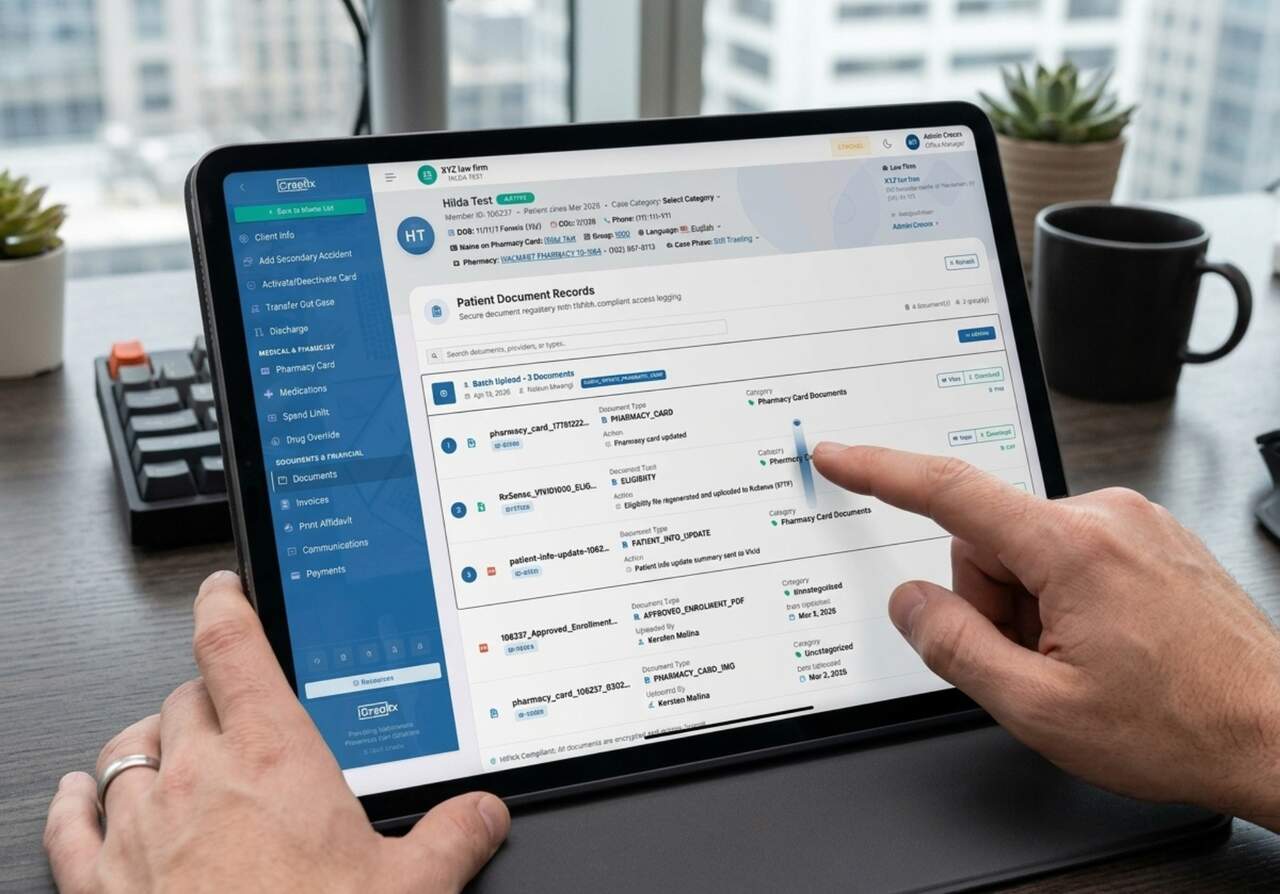
CreoRx provides pharmacy lien cards specifically designed for personal injury law firms. Enrollment takes minutes through the attorney portal, activation happens the same day, and the portal gives case managers real-time visibility into every client's fill history, card status, and running balance — without making a phone call.
For firms that handle significant volume, CreoRx integrates into intake as a standard step for clients without adequate prescription coverage. The result is fewer gaps in treatment, fewer pharmacy-related calls to manage, and cleaner settlement documentation when cases close.
Get your clients covered from day one
CreoRx activates pharmacy lien cards the same day you enroll — so your clients never have to wait for their prescriptions.
Book a Demo →