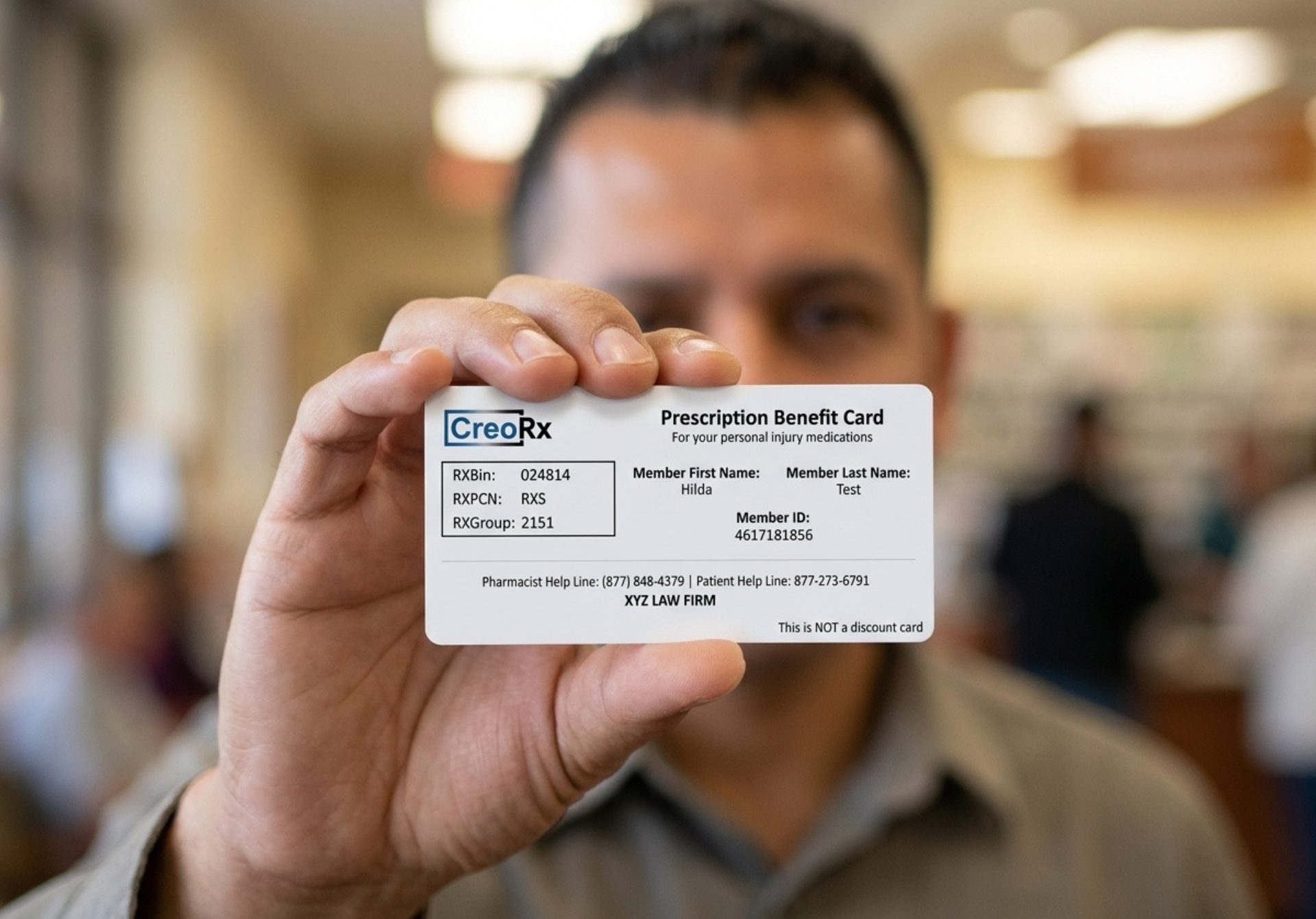
If your firm is searching for a lien pharmacy that pairs with the medical lien side of a personal injury settlement, the first step is understanding how the two arrangements differ. CreoRx is the lien pharmacy built around the pharmacy lien workflow specifically, and this article walks through how a lien pharmacy and a clinical medical lien provider operate side by side on the same case.
If you're managing personal injury cases, you're already familiar with liens — the legal mechanism that lets providers deliver treatment now and get paid at settlement. But "medical lien" and "pharmacy lien" often get used interchangeably, and they're not quite the same thing. Understanding the distinction matters for how you set up coverage for clients, how you track lien balances, and how you manage settlement disbursements.
Here's a clear breakdown of what each lien type is, how they differ operationally, and what those differences mean in practice.
What They Have in Common
Both pharmacy liens and medical liens share the same foundational structure: a provider delivers services or goods to a personal injury plaintiff without requiring payment upfront, holds a lien against the eventual settlement proceeds, and is repaid when the case resolves. In both cases, the attorney's office typically issues a letter of protection confirming they will honor the lien at settlement.
Both types of liens are also, in most well-structured programs, non-recourse with respect to the plaintiff — meaning if the case doesn't settle or results in a defense verdict, the lien provider absorbs the loss rather than pursuing the client personally. This is the risk-sharing structure that makes the arrangement viable for uninsured and underinsured plaintiffs who couldn't otherwise access care.
The shared core: Treatment or medication delivered today. Payment deferred to settlement. Lien held against the recovery. Attorney commits to honor the lien at disbursement. That structure is identical whether you're talking about a surgeon's fee or a prescription fill.
What Makes Pharmacy Liens Different
Pharmacy liens are a specific subcategory of medical liens — one defined by what's being provided (prescription medications) and how delivery is operationalized (through a card-based system at retail pharmacies rather than through a direct clinical relationship).
The differences are significant in practice:
The delivery mechanism
A medical lien typically involves a direct relationship between a clinical provider and the patient. The surgeon performs a procedure. The physical therapist sees the patient for a series of appointments. The provider invoices the lien company or holds the lien directly. The relationship is personal and clinical.
A pharmacy lien operates through a card-based system. The lien provider issues the client a card that works like insurance at participating pharmacies. The client presents the card, the pharmacy processes the claim in real time, the lien provider pays the pharmacy directly, and the balance accumulates as a running lien. There's no direct clinical relationship between the lien provider and the patient — the lien provider is purely the financial intermediary.
The frequency and granularity of transactions
Medical liens tend to involve a smaller number of high-value transactions — a surgery, a course of imaging, a series of specialist appointments. Pharmacy liens involve a potentially large number of smaller transactions — individual prescription fills, refills, and multiple medications over the life of a case. A client on a long course of treatment might generate dozens of pharmacy lien transactions totaling thousands of dollars.
This difference in transaction volume is why pharmacy lien management requires a purpose-built portal. Tracking 40 prescription fills across a caseload of 80 clients manually — the way some medical liens are still managed — would be unworkable. Good pharmacy lien software handles the transaction logging, balance tracking, and invoice generation automatically.
The spend limit structure
Medical liens are typically negotiated on a case-by-case basis — a surgeon agrees to treat for a certain procedure, and the lien amount is the fee for that procedure. There's a natural cap built into the nature of the service.
Pharmacy liens operate under an explicit spend limit set by the attorney's office at enrollment. The limit caps how much the lien provider will advance for a given client's prescriptions. This gives the attorney's office direct control over the firm's pharmacy lien exposure — something that doesn't have a direct equivalent in most medical lien arrangements.
Formulary restrictions
Medical lien providers generally cover whatever clinical services the treating physician recommends, within the scope of the agreement. Pharmacy lien programs maintain a formulary — a defined list of covered medications — that is typically limited to drugs directly related to the injury. Pre-existing condition medications and unrelated prescriptions are excluded. This is both a financial control mechanism and a way of keeping the lien clearly connected to the accident.
Documentation and invoicing
Medical lien documentation tends to be generated by the clinical provider — operative reports, office visit notes, billing statements. Obtaining this documentation at settlement requires coordinating with each provider individually, which can be time-consuming.
Pharmacy lien documentation, in well-run programs, is generated automatically. Every fill produces an itemized invoice — drug name, date, pharmacy location, cost — that is attached to the client's account in the portal and available for immediate download. No request, no wait, no coordination required.
"Medical liens and pharmacy liens solve the same access problem, but the operational model is completely different. One is a clinical relationship; the other is infrastructure."
Why "Lien Pharmacy" Is the Better Mental Model Than "Pharmacy Lien"
Personal injury attorneys often use "pharmacy lien" to describe the financial instrument and "lien pharmacy" to describe the operator who delivers the medication and holds the lien. Both phrases describe the same arrangement from different angles. When your client needs medications today and your firm needs clean invoicing at settlement, the practical decision is which lien pharmacy you call. CreoRx is the lien pharmacy that activates the card the same day the attorney acknowledges the lien, fills the prescription at any of 67,000+ pharmacies in the network, and produces the itemized lien invoice your demand package needs.
Side-by-Side Comparison
To make the distinctions concrete:
- What's covered: Medical liens cover clinical services (surgery, therapy, imaging, specialist visits). Pharmacy liens cover prescription medications directly related to the injury.
- How it's delivered: Medical liens through direct provider relationships. Pharmacy liens through a card used at retail pharmacies.
- Transaction volume: Medical liens — fewer, larger transactions. Pharmacy liens — many smaller transactions over the life of the case.
- Spend controls: Medical liens negotiated per service. Pharmacy liens governed by an attorney-set spend limit adjustable in the portal.
- Formulary: Medical liens cover whatever the provider recommends. Pharmacy liens are limited to an injury-related formulary.
- Documentation: Medical liens require coordination with each provider. Pharmacy liens auto-generate itemized invoices per transaction.
- Management: Medical liens tracked case by case. Pharmacy liens managed through a centralized portal with real-time visibility across all clients.
How They Work Together on the Same Case
In practice, many personal injury clients will have both types of liens active simultaneously. A client treating with an orthopedic surgeon under a medical lien will also need prescriptions — pain management, muscle relaxers, post-surgical medications — that are covered by a pharmacy lien. The two arrangements run in parallel, each accumulating a balance that is repaid at settlement.
At disbursement, both liens appear on the settlement statement and are paid before the client receives their net proceeds. The attorney needs accurate, itemized documentation from both — which is why the auto-generated invoicing in a good pharmacy lien portal is particularly valuable. One side of the documentation equation takes care of itself; the clinical side still requires coordination with each provider.
Which One Do You Need to Set Up at Intake?
For clients who are uninsured or underinsured, both. Medical lien arrangements are typically initiated through referrals to treating providers who work on a lien basis — your firm likely has established relationships with surgeons, imaging centers, and therapists who accept personal injury patients this way.
Pharmacy lien coverage is set up through enrollment with a pharmacy lien provider like CreoRx — a five-minute process through the attorney portal that results in a card the client can use the same day. For most firms, pharmacy lien enrollment should be a standard part of intake for any client who lacks prescription coverage, done the same day the file is opened rather than waiting for a pharmacy rejection to trigger it.
Get lien pharmacy coverage in place at intake
CreoRx is the lien pharmacy that enrolls clients in minutes with same-day activation. No paperwork, no phone calls, just a lien pharmacy card that works at the pharmacy your client already uses.
Book a Demo →