The pharmacy lien industry has operated largely the same way for decades. A law firm partners with a lien pharmacy. The pharmacy fills prescriptions for personal injury clients. The firm calls to check card status, requests invoices by phone, and waits for faxed documentation at settlement. It works — in the sense that prescriptions get filled — but the operational overhead is significant and almost entirely manual.
That's starting to change. A growing number of personal injury firms are moving away from traditional lien pharmacy relationships and toward portal-based solutions that give them direct, real-time control over every client's prescription coverage. The shift isn't driven by dissatisfaction with any one provider — it's driven by a broader recognition that the old model was built for a different era, and that the firms growing fastest are the ones that have modernized their operations.
What the Traditional Model Actually Looks Like Day-to-Day
To understand why firms are switching, it helps to be specific about what the traditional model requires operationally. A typical week for a case manager at a firm using a conventional lien pharmacy involves:
- Fielding calls from clients whose cards were rejected at the pharmacy, then calling the lien provider to diagnose the issue
- Calling to verify whether a specific medication is covered before a client attempts to fill it
- Requesting invoices for cases approaching settlement, then following up when they don't arrive promptly
- Calling to increase spend limits for clients whose cases have extended longer than expected
- Waiting on hold to confirm whether a new client's card has been activated
Each of these tasks is individually minor. Collectively, across a caseload of 60 or 80 or 120 active files, they consume a meaningful portion of a case manager's week — time spent on information retrieval and status checks rather than case work.
The math: A case manager averaging just 15 minutes per client per week on pharmacy-related calls burns over 1,000 hours per year on a 80-client caseload. That's more than six months of full-time equivalent labor spent on tasks that a portal eliminates.
What a Portal-Based Solution Changes
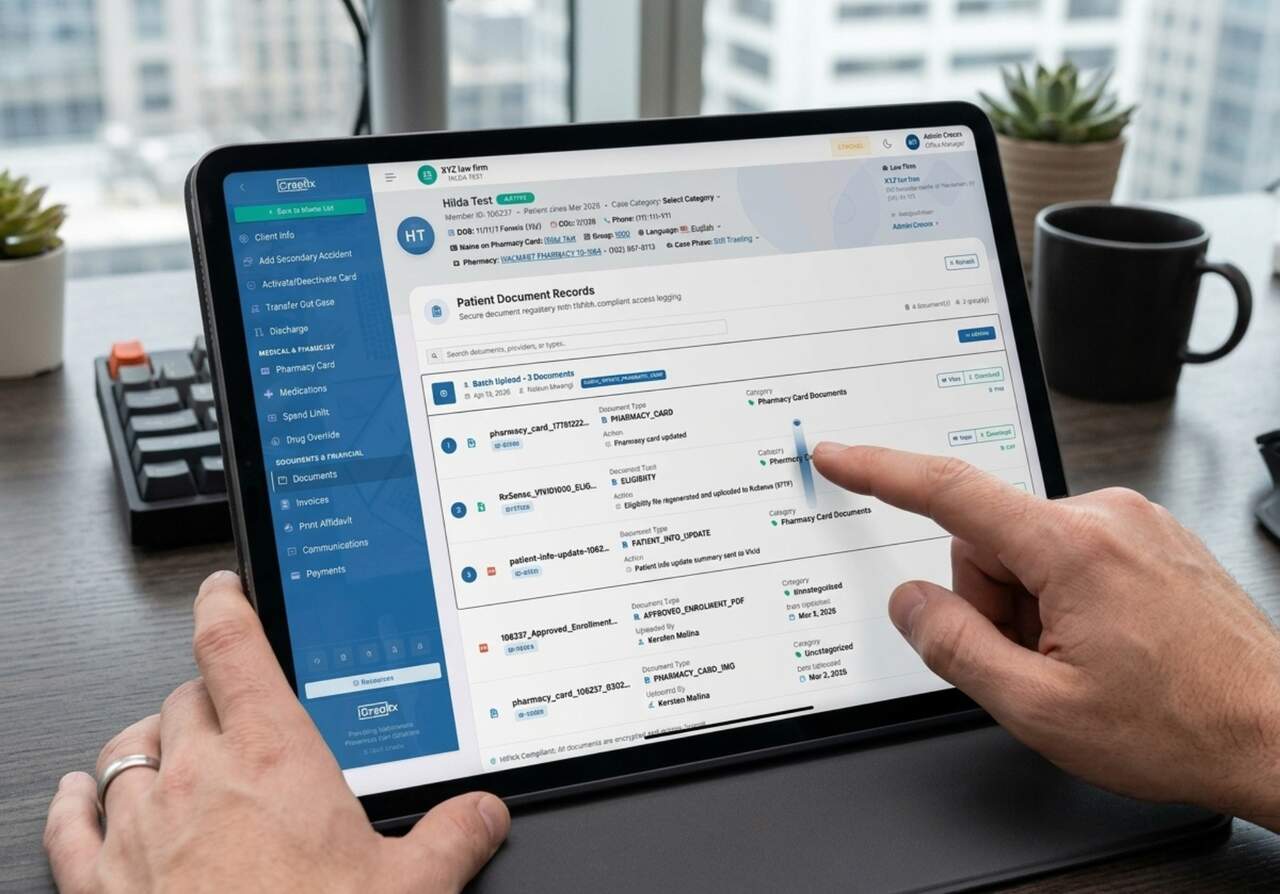
The core shift in a portal-based model is simple: information that previously required a phone call to obtain is now visible in a dashboard, in real time, without contacting anyone.
A well-built attorney portal gives case managers:
- Live card status for every enrolled client — active, inactive, or suspended — visible at a glance without a call
- Complete prescription fill history per client — every drug dispensed, every date, every pharmacy location, every transaction amount
- Running lien balance updated with each fill, so case managers always know current exposure without requesting a statement
- Auto-generated invoices attached to every transaction, downloadable immediately without submitting a request
- Spend limit controls adjustable directly in the portal — no call, no approval process, no waiting
- Same-day enrollment with card activation in under 30 minutes, handled entirely through the portal
The result isn't just time savings — it's a fundamentally different relationship with the lien management process. Case managers stop being reactive (waiting for problems to come to them) and can become proactive (checking portal data as part of routine case reviews and catching issues before they affect clients).
The Five Triggers That Prompt Firms to Switch
Most firms don't switch lien providers on a whim. The decision is usually prompted by one or more recurring pain points that have reached a breaking point. The most common triggers:
1. A case manager departure or caseload surge
When a firm loses a case manager or takes on significantly more cases, the hidden cost of the manual pharmacy workflow suddenly becomes visible. The new person can't absorb the same call volume. The existing team is stretched. The phone-based model that worked at 40 cases becomes untenable at 100. That's often when firms start asking whether there's a better way.
2. A settlement documentation scramble
A case heads to settlement and the firm needs a complete invoice history for the client's pharmacy lien. The provider doesn't have auto-generated invoices — they have to compile them manually. They take a week. The settlement gets delayed. It happens once and the firm tolerates it. It happens three times in a quarter and the firm starts evaluating alternatives.
3. A client who stopped treating
A case manager discovers at settlement prep that a client stopped filling their prescriptions four months earlier. Nobody caught it because there was no visibility into fill activity — no portal, no alerts, no proactive monitoring. The treatment record has gaps that weaken the case. The connection between a pharmacy rejection that was never resolved and a client who quietly disengaged is made in retrospect, too late to fix.
4. A rejected card that took days to resolve
A client calls from the pharmacy. The card isn't working. The case manager calls the lien provider and gets voicemail. The client calls back. The case manager calls again. The issue turns out to be a data entry error that takes a day and a half to resolve. The client goes without their pain medication for 36 hours. It's a minor incident in isolation — a firm-defining pattern when it happens repeatedly.
5. A growing firm that can't scale the old model
Some firms simply outgrow the traditional model. What worked at 30 cases doesn't work at 150. The phone call volume scales linearly with caseload. The invoice request backlog grows. The manual processes that were manageable at small scale become operational bottlenecks. The question isn't whether to modernize — it's when.
"We didn't switch because our old provider was bad. We switched because we were growing and realized we'd built our whole pharmacy workflow around making phone calls. That wasn't going to scale."
What to Evaluate When Considering a Switch
Not all portal-based solutions are equal. Some lien providers have added a basic web interface to their existing manual operation without fundamentally changing how the system works. Others have built purpose-built platforms from the ground up with attorney workflow in mind. The difference matters.
When evaluating a switch, the questions that separate real portal solutions from rebranded manual processes:
- Is fill history truly real-time? Or does it update with a lag that means you're still calling to confirm recent activity?
- Are invoices auto-generated per transaction? Or does the portal just show a balance, with invoices still requiring a request?
- Can spend limits be adjusted in the portal with immediate effect? Or does a portal request still route to a manual approval process on the provider's end?
- How fast is enrollment to activation? Same-day is the standard to hold providers to. Anything slower reintroduces the gap-in-coverage problem the portal is supposed to solve.
- Does the portal work at major retail chains? A portal that requires clients to use a specific pharmacy network reintroduces friction that defeats part of the purpose.
Addressing the Switching Cost Concern
The most common reason firms stay with underperforming lien providers longer than they should is the perceived complexity of switching. There are existing cases with lien balances. There are established relationships with the current provider's support team. Change feels like disruption.
In practice, the transition is simpler than it appears. The standard approach is to enroll all new clients with the new provider while allowing existing cases to run out naturally with the old one. This means no disruption to active cases, no transfer of existing lien balances, and a clean break that completes itself over three to six months as the existing caseload turns over.
The firms that have made this transition consistently report that the workflow improvement was noticeable within weeks of starting enrollment with the new provider — and that the one-time effort of running parallel providers during the transition was trivial compared to the time savings that followed.
How CreoRx Is Built for This
CreoRx was designed specifically for personal injury law firms that want to run their pharmacy lien program through a portal rather than a phone. Enrollment takes five minutes. Cards activate within 30 minutes. Every fill is logged in real time with full transaction details. Invoices are generated automatically and available for immediate download. Spend limits are controlled directly in the portal. The system works at major retail pharmacy chains — no proprietary network required.
For firms evaluating a switch, the most useful next step is a 15-minute demo that walks through how the portal actually works in practice. The difference between a real portal-based solution and a manual process with a web front-end becomes obvious quickly when you see it side by side.
See what a real portal looks like
15 minutes is enough to show you exactly how CreoRx replaces phone calls with portal visibility — from enrollment through settlement.
Book a Demo →